
No products in the cart.

COPYRIGHT © LA-STUDIO. ALL RIGHTS RESERVED.


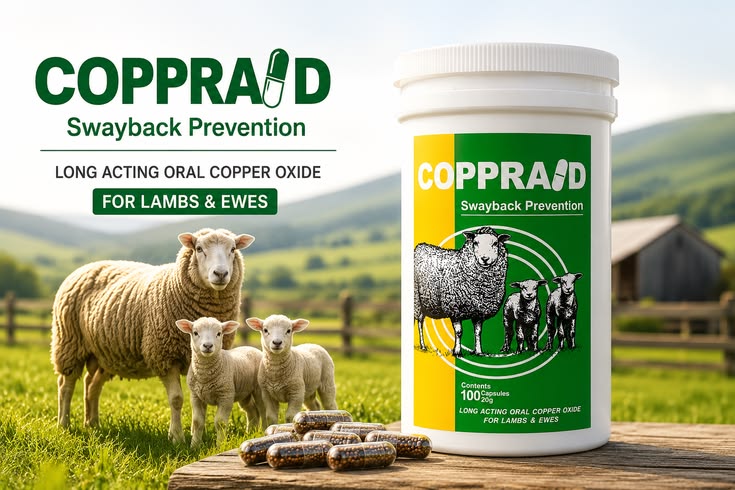
A lamb that was playing happily in the pen yesterday turns up on its back this morning. Its hindquarters bobble and its legs twist together like noodles as it struggles to rise. After a day or two, it can no longer get up at all. If you are a sheep farmer in the UAE (or have ever talked to one), you might recognize this one. Swayback is a devastating condition that affects many sheep farms, causing distress to the animals and worry to the farmers. By the time the lamb shows the tell-tale signs of the disease, its neurological system has already been damaged beyond repair.
The root cause, in the vast majority of cases, is copper. Not that there’s too much of it; it’s more often than not the lack of it during the ewe’s pregnancy, the period during which the future lamb’s spine needs copper to develop correctly. Once that period is over, it’s too late to intervene. That is when a long-acting copper oxide like Coppraid Capsules comes in handy, as a tool to assure proper copper levels in ewes in order to prevent swayback from ever occurring.
Soil and Forage Limitations
Firstly, much of the UAE’s agricultural land, which is used for grazing or fodder production, is naturally deficient in trace minerals. Secondly, a considerable proportion of the feed comes from external sources, where its content in terms of minerals can be difficult to estimate. Meanwhile, a seemingly healthy diet high in protein and energy may be insufficient in terms of copper, which frequently results in animals’ intolerance to stress.
Copper deficiency may not always be due to a dietary deficiency. It may also occur when other elements such as molybdenum and sulphur are present in excess in the animal’s diet. These elements combine with copper to make it unavailable for absorption and utilization by the animal. This type of deficiency is referred to as induced copper deficiency. A good example of this is where farmers assume that they are not deficient because they are adding minerals to the feed, when in reality, there is another constituent which is combining with copper to make it inert.
A ewe’s copper requirement increases substantially during the last third of pregnancy, when lamb brain development reaches its peak. This is also the period during which a marginal copper status can cause the most harm to the developing fetus, and it coincides with a time of year when many UAE flocks are managing multiple stress factors simultaneously.
What happens is that when the capsule is ingested it dissolves in the rumen and then releases fine particles of copper oxide which are then able to sink down through the digestive tract to the abomasum (the ‘true’ stomach of the sheep). Once there, they slowly erode releasing small amounts of copper over a long period of time.
This slow release is obviously of value since a short-acting oral drench would only be useful if the animal was deficient at the time of dosing.
A long-acting capsule, by contrast, will slowly release copper into the gut over weeks and months, making it much more valuable in helping to maintain copper status during the late gestation period when ewes require an increased copper intake.
Copper dosing should be individually tailored to each flock, animal weight, breed sensitivity, and degree of deficiency risk in your area. Copper is a highly specific trace element, and excess can be as harmful as deficit. The Table below is only a guideline to the overall flock management schedule and should be confirmed with your local veterinarian and product insert before administration.
Animal Group | Recommended Timing | Dose | Purpose / Benefit |
|---|---|---|---|
Ewes (pre-breeding / mid-pregnancy) | As advised by your vet, typically several weeks ahead of lambing | Per product label / veterinary dosing guidance | Builds maternal copper reserves so lambs are protected from birth |
Lambs in known deficient flocks | From the age range your vet recommends for your flock | Per product label / veterinary dosing guidance | Direct correction where a copper shortfall has been identified |
Ewes in copper-deficient regions | Repeated on a schedule set by your vet (often seasonal) | Per product label / veterinary dosing guidance | Ongoing prevention across breeding cycles |
1 .Getting a capsule into a sheep may sound simple but a rushed or careless administration is a common reason why a dose fails to achieve desired results. Here’s a guide to help avoid these pitfalls.
2 .Confirm the need first. Wherever practicable confirm the requirement for treatment through blood/liver copper analysis or by checking local deficiency patterns, rather than dosing blindly.
4 .Use a proper capsule/balling gun. Insert using an appropriate applicator and place the capsule towards the back of the tongue.
5 .Let the animal swallow. Keep the ewe’s/lamb’s head level or slightly raised for a short time and avoid forcing the head back, as this increases the chance of the capsule entering the windpipe.
6 .Watch for regurgitation. Some animals will cough the capsule out with the first few mouthfuls so always make sure it has been swallowed before going to the next animal.
7 .Record the date and animal identification. This will help build up a reliable flock/parturient record for future reference and optimal supplement timing.
8 .Store the capsules correctly. Keep in a cool, dry place away from direct sunlight, and out of the reach of children.
9 .Check before supplementing. If the flock is being supplemented by any other means (licks, boluses, etc) contact your veterinary surgeon before use; there is a risk of copper overdose if given in combination with any other copper-containing product.
How does Coppraid differ from a regular copper drench or injection?
A standard drench or injection will provide a rapid dose of copper to the system, but this will dissipate quickly. Coppraid is designed to provide a long-lasting release of copper into the system after a single oral dose, which may be important for the longer term copper needs such as during pregnancy.
When should ewes be given Coppraid capsules to protect their lambs?
The timing of treatment should be determined by your veterinarian on an individual basis, taking into account the specific requirements of your flock. As a general guide, copper should be supplemented to build up reserves in the ewe prior to the last trimester of pregnancy when the foetus is undergoing rapid neurologic development.
Can Coppraid be given directly to lambs?
Coppraid may be administered to lambs and ewes as described in the product datasheet. In addition, lamb specific supplementation should be considered based on your level of risk and determined by your veterinarian.
Is copper toxic to sheep if overdosed?
Yes. Copper has a relatively narrow therapeutic window in sheep and there are some breeds that are more susceptible to copper toxicity than others. This means that treatment should not be undertaken on an ad-hoc basis and should only be conducted following suitable veterinary advise or in accordance with the manufacturer’s guidelines.
How long does one Coppraid capsule last in the animal’s system?
It is designed to release copper slowly into the system as opposed to a single large dose and the length of time this occurs for will depend on the situation and the veterinarian involved. For specific guidance in your situation, please refer to the veterinary datasheet or speak to your veterinarian.
Do all sheep breeds need the same copper dose?
No. Copper sensitivity and requirements can vary substantially between breeds, which is why a particular approach of single dose for all is potentially dangerous. Always consult your veterinarian for the correct breeding-specific dosage.
Where can UAE farmers buy Coppraid capsules?
The Coppraid 100 Capsules can be ordered from World Cart’s online catalog, see link below, where the shipping options are also described.
Swayback is one of those issues that are much easier to prevent than they are to treat. Prevention includes providing your ewes with proper copper reserves during pregnancy. If your flock is at risk, that means if they are grazing in areas where soil is deficient in copper, or if swayback has been a problem in your operation in the past, then it is important to have those mineral programs discussed with your veterinarian before breeding begins; not at the first sign of lambing difficulty.
A long-acting mineral like Coppraid fits in perfectly with this type of program. The appropriate dosage is administered ahead of time, proper records are kept, and the slow release of copper provides a steady boost that a single treatment couldn’t.

COPYRIGHT © LA-STUDIO. ALL RIGHTS RESERVED.